
Enterprise AI Strategy - Vendor Lock-in and Your Choices
Elevating architectural choices to strategic decisions, retain optionality, and avoid costly future migrations.

Your engineering team made some key AI architecture decisions last quarter. Unless you are a CTO, you probably weren’t in the room for any of them.
That’s the problem.

Tech strategy conversation in 2026 is focused on the wrong AI layer. Strategy teams are asking: which LLM should we standardize on? Are we too dependent on OpenAI? These are reasonable questions, but they’re already behind the curve.
For most text-generation and classification workloads, GPT-4-class capability is now commodity: token costs have dropped 300x since 2023, and multiple vendors offer equivalent performance at near-zero marginal cost.
For reasoning-heavy, multimodal, and domain-specific tasks, model differentiation is actually intensifying. Frontier reasoning models command premium pricing and deliver materially different outcomes on complex workloads. But this reinforces rather than undermines the thesis: enterprises increasingly need multi-model architectures, which makes the layers around the model even more critical.
The lock-in question has moved. And it has moved to layers most strategy professionals aren’t watching. It moved simultaneously, in three distinct parts of the stack. The choices you make at each layer compound. Enterprises that are making all three decisions independently, without mapping how they interact, are making a strategic mistake that will be costly to correct in the future.
Before we unpack each layer, here is where the landscape is settling.
The Four Camps, and Why the Choice Compounds
This is the insight most strategy teams are missing. Cloud infrastructure, data platform, and workflow orchestration are not independent, layer-by-layer decisions. They interact, compound, and are often implicitly determined by a single upstream choice - your primary enterprise software vendor or cloud provider.
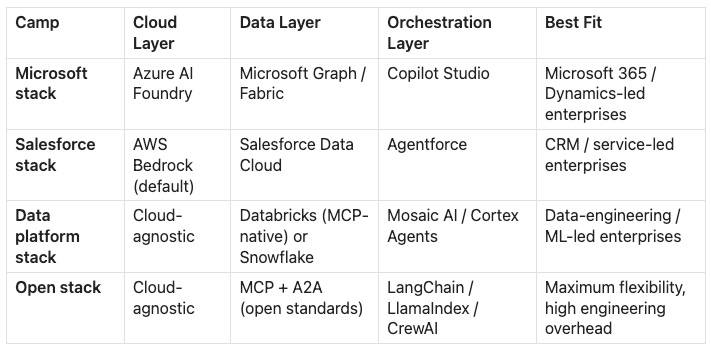
The most dangerous outcome is not choosing one camp. It’s ending up in multiple camps by default, because different business units made independent tooling decisions.
An enterprise running Agentforce for sales workflows, Databricks for ML pipelines, and Bedrock AgentCore for cloud-native agents is accumulating lock-in at all three layers from different vendors simultaneously, with no unified governance model and compounding migration complexity.
Only one in five companies has a mature governance model for autonomous agents, yet 74% plan to deploy agentic AI within two years. Gartner projects that more than 40% of agentic AI projects will be canceled by end of 2027.
The architectural decisions that determine lock-in for the next decade are being made now, before production commitments have hardened, and before strategy teams are in the conversation.
To understand how the compounding works, we need to look at each layer individually.
What Happened When Tech Commoditizes
When a technology commoditizes, the strategic value doesn’t disappear, it migrates. When internet bandwidth commoditized, value moved to the application layer. When cloud compute commoditized, value moved to managed services and data platforms. When databases commoditized, value moved to analytics and workflow layers.
The same shift is happening in AI. Except it is happening across three layers simultaneously: cloud infrastructure, data platforms, and workflow orchestration. Each layer has its own platform war forming.
The choices you make at each layer compound. And most enterprises are making all three decisions independently, without anyone mapping how they interact.
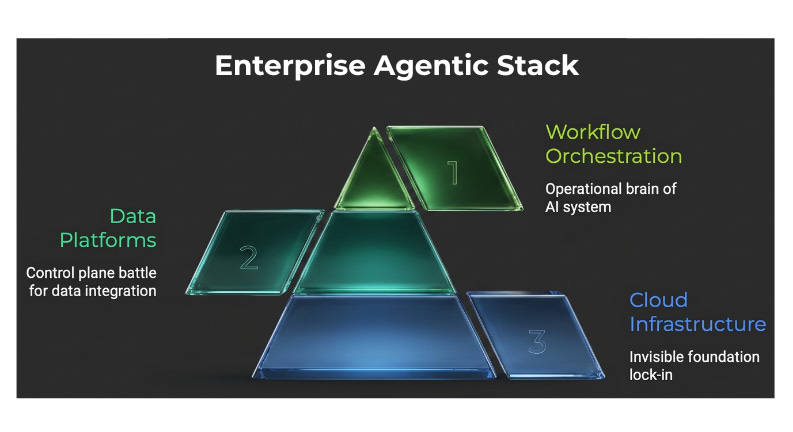
Layer 1: Cloud Infrastructure : The Invisible Foundation Lock-In
Before you even get to your data or your agent workflows, your cloud provider is quietly becoming your AI infrastructure lock-in, and this is the layer most strategy teams are least aware of.
AWS and Google are taking diametrically opposed approaches to AI agent management, revealing a fundamental split in how the cloud layer is being built.
AWS Bedrock AgentCore optimizes for velocity. Its managed agent harness lets teams define what an agent does, which model it uses, and which tools it calls — and AgentCore assembles the rest. Identity management, session state, memory, and tool orchestration are all handled by AWS’s runtime. AgentCore offers genuine framework and model portability by design. It works with LangGraph, CrewAI, Strands, and supports non-Bedrock models.
The lock-in operates at a different level: IAM identity, VPC networking, session state, and observability all become AWS-native. The agent logic may be portable; the operational scaffolding around it is not.
Google Gemini Enterprise Platform (Vertex AI rebranded at Cloud Next 2026) takes the opposite approach: a Kubernetes-style centralized control plane governing agent identity, policy enforcement, and long-running behavior monitoring. Governance is the product. Lock-in is the consequence.
Azure AI Foundry occupies the Microsoft position: deeply embedded in the Microsoft 365, Dynamics, and Azure ecosystem, where the AI agent layer and the enterprise software layer are being merged into a single commitment.
The strategic implication: enterprises building agentic workloads on any of these platforms are not just choosing a compute provider. They are embedding their agent architecture into a specific runtime, observability stack, and identity management framework. Switching costs compound at every layer above the infrastructure.
Layer 2: Data Platforms : The Control Plane Battle
Every AI agent needs to connect to your data. How that connection is governed determines whether your AI stack is portable, or permanently tethered.
Four forces are competing for the data integration layer:
The open standards: MCP and A2A
Two complementary protocols are emerging as the open standard stack for agentic AI. Anthropic launched MCP (Model Context Protocol) in November 2024 as a vendor-neutral standard for agent-to-tool connectivity. Effectively TCP/IP for AI agents. In January 2026 it was donated to the Linux Foundation with OpenAI and Block as co-contributors. Adoption is moving fast: 78% of enterprise AI teams report at least one MCP-backed agent in production as of Q1 2026, up from 31% one year earlier. MCP SDK downloads have reached 97 million monthly, a 970x increase in 18 months.
Google’s A2A (Agent-to-Agent) protocol addresses the complementary problem: how agents from different vendors and platforms coordinate with each other across organizational boundaries. Launched in April 2025, A2A has grown from 50 technology partners to over 150 organizations in one year. Both protocols now sit under the Linux Foundation’s Agentic AI Foundation co-founded by OpenAI, Anthropic, Google, Microsoft, AWS, and Block. This is a clear signal that these are industry standards, not single-vendor specs.
MCP governs agent-to-tool connectivity. A2A governs agent-to-agent coordination. Enterprises building multi-camp architectures should track both.
Databricks - betting on MCP as the governance layer
Databricks has gone explicitly MCP-native at the data layer. In April 2026, it embedded MCP governance directly into Unity Catalog via Unity AI Gateway, making Unity Catalog the enterprise control plane governing how agents access LLMs, call external tools, and interact with MCP servers. Databricks’ own 2026 State of AI Agents report claims enterprises using their governance tools get 12x more AI projects to production, a self-reported figure, but directionally consistent with the broader finding that only ~15% of AI agent pilots reach production scale, and governance is the strongest predictor of which ones do.
The Databricks bet: own the governed data layer, be MCP-native for portability, and lock enterprises into Mosaic AI Agent Bricks for orchestration.
Snowflake - the parallel data control plane play
Snowflake has made the same strategic move from a different starting point. In April 2026, it positioned itself as the “control plane for the agentic enterprise” via two products: Snowflake Intelligence (a personal work agent grounded in governed enterprise data) and Cortex Code (an agent builder layer letting teams create and orchestrate agents inside the Snowflake data perimeter). Cortex Agents reached general availability in November 2025, handling multi-step planning, tool use, and structured/unstructured data orchestration, all within Snowflake’s governance framework. Since launch, more than half of Snowflake customers are using Cortex Code, which now extends across external data systems including AWS Glue, Databricks, and PostgreSQL.
The risk for both: CIOs who have lived through prior platform lock-in cycles know this all too well. The vendor that becomes your data control plane today is the vendor you depend on for every future architectural move.
The proprietary connector path: Salesforce and Microsoft
Simultaneously, Salesforce Data Cloud and Microsoft Graph API are expanding proprietary connector ecosystems that embed their data models, identity frameworks, and activation logic deep into enterprise workflows. These connectors are more than data pipes, they are architectural commitments. The deeper you go, the harder the exit.
Layer 3: Workflow Orchestration : Where Agent Logic Lives
The orchestration layer defines how agent workflows run: how tasks decompose, how agents hand off, how memory persists, how failures are handled. This is the operational brain of your AI system. It is where the most visible platform war is playing out.
Full-stack CRM platform enclosure: Salesforce Agentforce and Microsoft Copilot Studio
Both platforms offer real enterprise value: faster time-to-value, enterprise SLA support, pre-built governance, and deep CRM/ERP integration that open frameworks cannot match out of the box. The tradeoff is structural dependency. These platforms are architecturally incompatible with each other. Enterprises are deploying both simultaneously across different business units, creating governance seams and integration debt that compounds over time. This is the early pattern of Oracle-SAP dual deployments that IT organizations spent the 2010s untangling.
Data-platform orchestration: Databricks Mosaic AI and Snowflake Cortex Agents
For enterprises whose core AI workloads are built on data engineering and ML pipelines rather than CRM workflows, Databricks and Snowflake are offering managed orchestration native to their data platforms. Databricks’ Supervisor Agent went from launch to 37% of all Agent Bricks usage within four months. Both approaches keep orchestration close to the governed data layer, which is their competitive advantage and their lock-in vector.
Open frameworks: maximum optionality, maximum complexity
LangChain, LlamaIndex, CrewAI, and AutoGen represent the fully modular alternative. Combined with MCP for data integration and A2A for agent coordination, this path offers the highest long-term portability. The tradeoff is equally real: open frameworks are failing in production due to orchestration-layer brittleness — silent failures, undocumented retry behavior, no native enterprise governance tooling. The framework choice matters because switching later is expensive: agent logic, tool definitions, memory architecture, and deployment patterns all couple to the framework’s abstractions. The fully open path demands the most engineering investment and carries the highest production risk.
A protocol may help one agent call another tool, but it does not automatically make agent memory portable, preserve workflow configuration, transfer escalation habits, or recreate behavioral calibration. Operational portability is harder than protocol portability.
The M&A and Partnership Diligence Implication
For strategy teams evaluating acquisitions or deep technology partnerships, the camp question is now a diligence variable.
An AI-forward acquisition target built deeply on Agentforce + Salesforce Data Cloud + Azure has three compounding lock-in layers that affect integration complexity, technology debt valuation, and post-merger architectural optionality. A target built on open frameworks with MCP-native data integration is materially more portable, but also more operationally fragile if their engineering organization is thin.
The camp question belongs in your diligence checklist.
What to Do Next
1. Map your current AI commitments across all three layers. Most enterprises don’t have a single view of which cloud runtimes, data platforms, and orchestration frameworks their teams are using for AI workloads. Build that map before your next architecture review.
In order to make Frontier Signals more actionable, a Strategic Exposure Assessment Framework to assess AI commitments and vendor lock-in is Coming soon!
Sign Up if you would like access to it and future Frontier Frameworks.
2. Determine which camp you’re drifting into and whether that’s deliberate. If different business units have independently chosen Agentforce, Databricks, and Bedrock AgentCore, you are accumulating multi-camp lock-in with no unified governance model. That’s a strategic risk, not a technology problem.
3. Establish governance before production commitments harden. The evidence is clear: enterprises with mature AI governance models get dramatically more projects to production. The 78% of companies without mature agent governance are making the most consequential architectural commitments with the least strategic oversight.
4. Evaluate open standards as an insurance layer. MCP and A2A adoption is accelerating fast enough that they represent a credible portability hedge. Even enterprises committed to a primary vendor stack should ensure their data and agent coordination layers can interface with open standards. The switching cost of adding MCP/A2A compatibility now is far lower than migrating away from a proprietary connector ecosystem later.
5. Put the camp question in your M&A and partnership diligence. If you’re evaluating an acquisition target or strategic technology partner, map their AI stack across all three layers and assess camp alignment, migration complexity, and governance maturity.
Signals We Are Tracking
MCP/A2A standard consolidation:
Track whether OpenAI, Google, and Meta ship full MCP-native integrations in production APIs (not just announcements).
Watch A2A adoption beyond Google’s ecosystem. Enterprise production deployments, not partner logos.
Monitor whether MCP enterprise pilot-to-production conversion rate (currently ~26%) crosses 40% by end of 2026
Cloud infrastructure divergence:
AWS AgentCore vs. Google Gemini Enterprise Platform adoption split - which runtime becomes the default for new agentic workloads?
Watch for multi-cloud agent portability tooling from third parties (Cloudflare, Pulumi) as a signal that enterprises are demanding escape hatches
Data platform control plane war:
Databricks vs. Snowflake: which becomes the default governance layer for agent-data access?
Track whether Salesforce Data Cloud or Microsoft Fabric absorb enough of the data layer to make the two-platform (CRM + data) architecture viable
Orchestration framework maturity:
Open framework production failure rates — are LangChain/CrewAI/AutoGen closing the reliability gap, or are enterprises retreating to managed platforms?
Watch for a consolidation event (acquisition or standard-setting) in the open orchestration space
Regulatory and compliance overlay:
EU AI Act enforcement timelines and how they interact with vendor governance tooling
Sector-specific AI compliance requirements (financial services, healthcare) that may force vendor choice
If you found this post useful, considering subscribing to receive more forward-looking analysis — written for strategists and practitioners who need to make big decisions in the face of a rapidly shifting Tech Frontier.
We cut through the noise of AI hype and excitement surrounding Frontier technologies like Quantum, Space, Energy, and Climate to provide a clear, evidence-based signal on what’s actually changing and its implications for your strategy.
If you know someone who can benefit from Frontier Signals, please share this post and publication with them.